
Inside the Rundown: 6 Insider Truths About Local TV News with Boston 25’s Kelly Sullivan

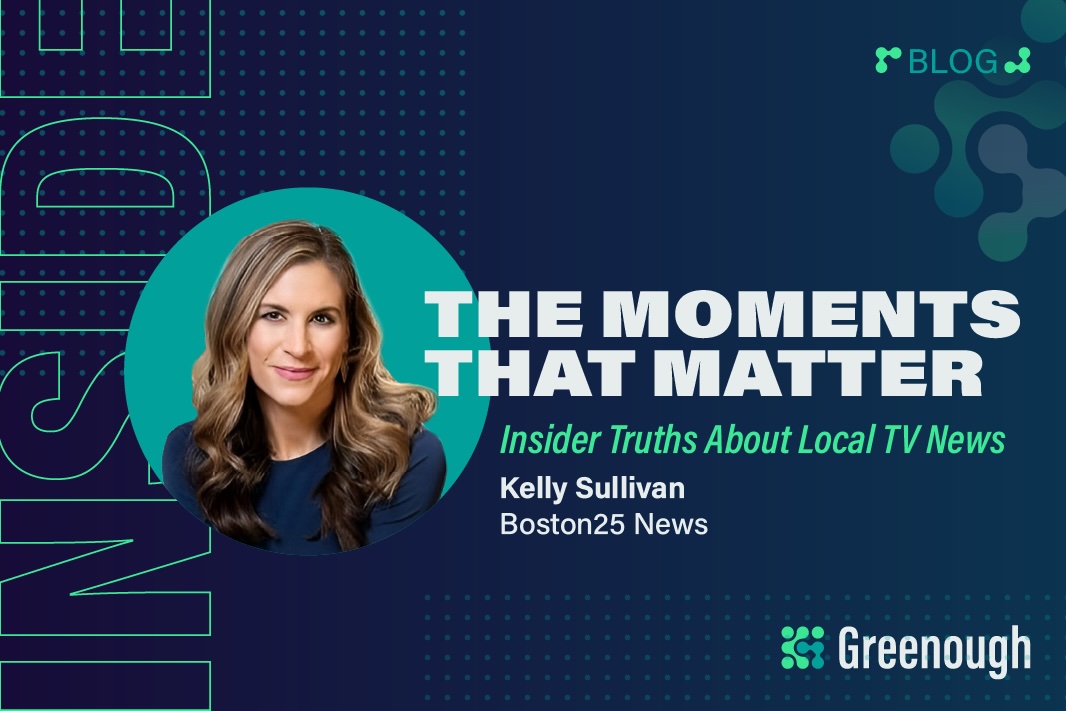
Local TV news is quietly reinventing itself in plain sight. Even as audiences shift to streaming apps, social video and on-demand clips, community newscasts remain one of the most trusted, widely consumed sources of information in the media ecosystem.
Viewers are no longer just tuning in at 6 and 11—they’re watching local stations on connected TV apps in rapidly growing numbers, with some markets seeing app viewing jump by nearly 70% year over year.
In this always-on, multiplatform reality, local broadcasters are still doing what they’ve always done best: telling deeply human, close-to-home stories. To unpack how that works on the ground and what organizations need to understand if they want to break through, we sat down with Kelly Sullivan, reporter and fill-in anchor at Boston 25 News, for a behind-the-scenes Q&A.
Below are six insights from Kelly that reveal how local TV really works today and how you can shape stories that resonate on air, online and everywhere in between.
1. Local Before Anything Else: Why Community Reporting Still Matters
Q: What makes local broadcast reporting different from national news and why does it still matter so much to communities?
Local news is built on proximity and trust. Kelly puts it simply: local TV exists to serve the community directly in front of it.
“Local reporting really focuses on local, nonbiased reporting. National networks might have a slight lean one way or the other. That’s why local reporting matters. It focuses on the facts of local communities, informs viewers, and then allows them to form their own opinions.”
While national outlets chase big political narratives or coast-to-coast trends, local stations zero in on school committees, zoning boards, neighborhood safety, main street businesses and local leaders. That’s precisely where people feel the impact of policy, economics and culture most acutely.
Recent industry research backs this up: audiences consistently rate local news as more trusted and more personally relevant than other types of news coverage. When a snowstorm is coming, a bridge closes, or a ballot question could change your tax bill, viewers turn first to the people who live and work where they do.
What this means for communicators trying to break through to local broadcast media:
- Lead with local stakes, not national talking points.
- Be clear about who in the community is affected, how many people are impacted, and what changes if your story goes untold.
2. From Inbox to On-Air: How Stories Make the Cut
Q: How do you decide which local stories are worth including in a newscast?
Every day, newsrooms are flooded with releases, tips, and “great story ideas.” Only a handful survive the morning meeting. Kelly’s decision-making lens is remarkably consistent:
“The story needs to be relatable and impact a lot of people. It can also create an emotional connection or focus on issues that affect viewers.”
Picture a producer weighing two pitches at 3 p.m.:
- A ribbon cutting for a new corporate office.
- A local nonprofit and a neighborhood mom working together to keep a warming center open after funding was cut.
The second pitch wins almost every time. It hits Kelly’s criteria: broad impact, emotional resonance, and a clear connection to viewers’ daily lives.
For communicators:
- Translate your message into real-life consequences: “This will change commute times for 40,000 people,” or “This program helps 500 local families a year.”
- Make the emotional arc obvious: who’s struggling, who’s stepping up, and what’s at stake if nothing changes.
3. It’s Not Cable News: The Biggest Misconception About Local TV
Q: What’s one misconception people have about how local TV news works behind the scenes?
In an era of nonstop national commentary, many people assume local TV is just a smaller version of cable news. Kelly is clear: it’s not.
“Local TV is different from the cable networks. Local TV focuses on local people.”
That difference shows up in everything from story selection to tone. Instead of panels of pundits arguing about a national storyline, you’re more likely to see:
- A crossing guard who’s become a neighborhood fixture.
- A local parent advocating for special education resources.
- A small business owner explaining how policy changes hit their bottom line.
Behind the scenes, that focus on people means producers and reporters are constantly asking: “Who can we talk to in our own backyard who brings this to life?”
For communicators:
- Avoid framing your story as generic “thought leadership” or a national hot take.
- Offer local voices - customers, patients, residents, workers - who can speak authentically, not just executives or spokespeople.
4. The “We Have to Do This” Test: What Makes a Story Unskippable
Q: When a story crosses your desk, what makes you say, “This is one we need to cover”?
It takes more than a good idea to rise to the top of a crowded rundown. For Kelly, a must cover story checks three boxes:
“It’s a story that highlights an important issue for our viewers, has good video, and would keep people’s attention.”
In other words, the story must be:
- Important – It surfaces a real issue or opportunity for local people.
- Visual – There’s something to see: a place, an event, a process, a problem.
- Engaging – The narrative will hold attention, whether on a TV screen or a social feed.
This “triple test” has only grown more critical as local news embraces a push everywhere mentality: publishing across broadcast, websites, apps and social channels instead of relying solely on traditional appointment viewing.
For communicators:
- Ask yourself honestly: “Is there something visually compelling here, or do we just want attention?”
- Frame your pitch with a clear central conflict or question: What’s changing? Who disagrees? What might happen next?
5. If It’s Not Visual, It’s Not TV: Why Pictures Drive the Story
Q: How do visuals and storytelling factor into whether a story works for broadcast?
In local TV, the camera isn’t just a recording device—it’s the audience’s seat in the story.
Kelly doesn’t mince words about how much that matters:
“Visuals are a big part of TV and if we have good visuals, we are more inclined to tell the story. Zoom interviews or interviews with people in plain conference rooms is not eye-catching and doesn’t hold people’s attention.”
As more viewers watch local stories through clips on social platforms and streaming apps, that visual bar only gets higher. A talking head in a windowless room simply can’t compete with dynamic, on location footage in an endless scroll of video.
Bringing Your Story Closer to Home
Local TV news may be evolving across platforms, but Kelly Sullivan’s playbook makes one thing clear: the fundamentals haven’t changed. If you want your story to break through on air, on apps, or in a two-minute social clip you need clear local stakes, real people at the center, and visuals that pull viewers into the scene, not just the message.
You can see those principles at work in the stories we partnered on with Kelly, from showcasing Element Care’s partnership with 2Life Communities to provide affordable, service‑rich housing that lets Massachusetts seniors age with dignity and support, to telling the BioBuilder and Sunflower Therapeutics story through local students whose passion for science turns into real STEM careers.
For communicators, reaching local broadcast media means thinking less like a press release and more like a neighborhood story: who is affected, what they can see and feel, and why it matters right here, right now. When you ground your pitch in the lived experience of the community, you’re not just asking for coverage, you’re offering the kind of reporting local audiences still trust most.
What our clients say

Ameresco
Leila Dillon, SVP, Corporate Marketing and Communications
It's clear that the Greenough Communications team has a deep understanding of the clean tech and climate transition spaces. Within the first month of working together, they were able to land interviews with The Washington Post, The New York Times and Canary Media, just to name a few! Since working together, we've seen our media coverage and quality increase significantly across the board. We value Greenough's partnership are looking forward to our continued work together.

Boston Micro Fabrication
Laura Galloway, Marketing Director
As a small marketing team, having an agency partner that feels like a true extension of my team is invaluable. The Greenough Communications team is professional, responsive and has taken the time to understand our business, putting our brand in front of the customers who matter for our growth. I’ve been very happy with our first year of partnership and look forward to future success.

Acrolinx
Mariana Just, Vice President, Marketing
We started working with Greenough Communications over a year ago, and it's been a fantastic journey. They really understand who we are at Acrolinx and what we want to say. Their ability to amplify our message in a crowded AI space has been impressive, delivering solid media results in the outlets that matter, securing the AI Breakthrough Award, and boosting our executive team's social media presence. As we continue our partnership, we're excited about expanding our reach and market presence, building upon our refreshed positioning and messaging with Greenough's expertise guiding us every step of the way.

IQE
Steven Curwood, Director of Corporate Marketing
At IQE, one of our goals is to demystify the vital role compound semiconductors play in the industry and the future of innovation. As we aim to broaden our brand's reach in the U.S. market, finding an agency that understands our technology and the intricacies of our work is crucial. Greenough Communications stood out as that agency from the start. In the short time we've worked together, they've already validated our choice with opportunities in key media, including CNBC, NPR, and the U.S. trade media that will move the needle for our brand and message. There's much ahead for us, and we're excited to have the Greenough team by our side.

Arbella Insurance
John Donohue, CEO
Our Greenough team has excelled in learning our business and our challenges and has been extremely effective in developing and executing a PR strategy that helps drive our success.

Wolters Kluwer Health
André Rebelo, Global Marketing Communications & Public Relations
Our Greenough team has been a strategic asset in sustaining targeted growth in our PR and external communications. The team really operates like an extension of our internal team, aligned and effective. They've deftly balanced the needs of multiple sub-groups' objectives and needs, getting great results in the publications our customers read.

GlobalFoundries
Laurie Kelly, Chief Communications Officer
Greenough Communications has been more than just a PR agency for us at GlobalFoundries; they've been true partners. From navigating our IPO to driving impactful education campaigns like the one leading up to the passage of the CHIPS Act, they've been instrumental in showing the world our leadership role in this new technology era. Their knack for building connections with the industry and our team, including our executives, has been impressive. Every year, we throw new challenges their way, and they keep delivering. As we move ahead together, we're excited to keep pushing the boundaries, sharpening our brand narrative, and taking our brand awareness to the next level.

Integrated Marketing
Content Development
Public Relations
Brand Strategy
Integrated Marketing
Content Development
Public Relations
Brand Strategy
Public Relations
Brand Strategy
Integrated Marketing
Content Development
Public Relations
Brand Strategy
Integrated Marketing
Content Development
Let's start a project together.

