
2026: The First AI‑Native Year for Brands, Where Validation Beats Visibility

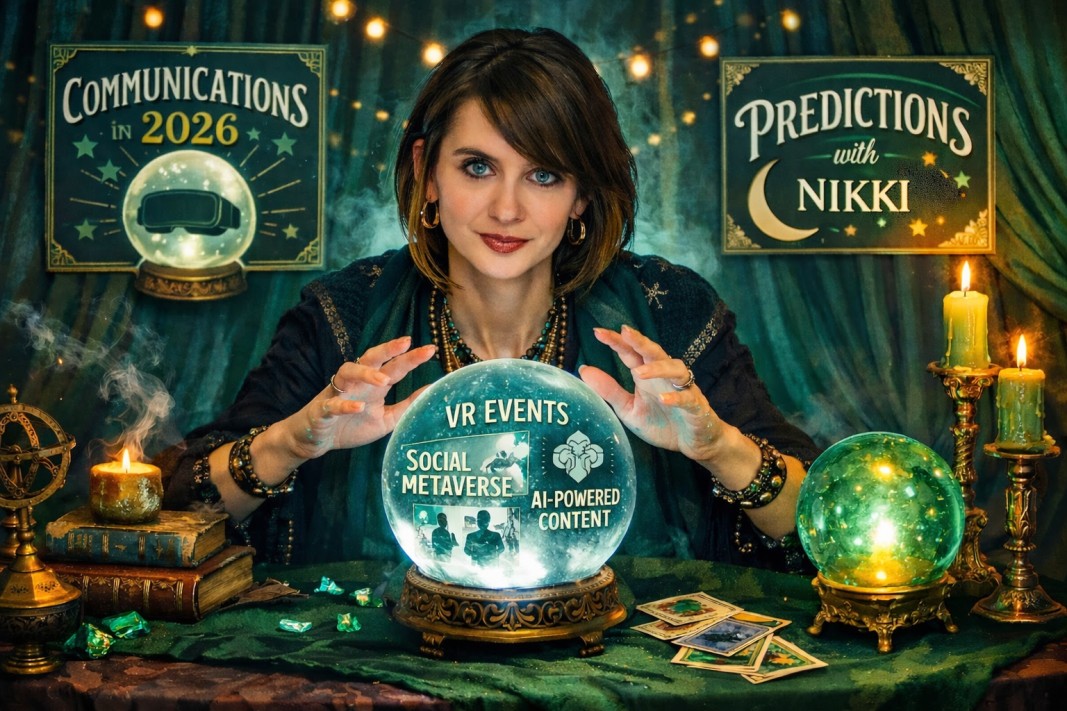
While we spent a lot of time talking about AI in the 2024 and 2025 predictions pieces, 2026 is poised to be the first true “AI-native” year for brand marketing and communications. The experimentation phase is over; AI will power everything from audience discovery and message architecture to creative iteration. The result will, in most cases, be faster cycles, sharper personalization, and a shift in how stories are crafted, distributed, and measured.
In short, AI will not just make communications teams more efficient; it will become the engine of brand growth, shaping briefs, generating initial content drafts, and optimizing performance in real time. This is exactly what we mean when we cite Greenough’s charter of being AI-powered, human-led.
But we can’t gloss over the productive tension that has been bubbling to the surface and needs to be tackled. According to research revealed at Ragan’s Future of Communications Conference, AI is now present in 95% of communications departments, and nearly a third say AI already does more than half of their comms work, with these numbers expected to grow meaningfully by 2030. At the same time, 83% of CEOs say they still “very much” value the comms function for its most human strengths, such as strategy, creativity, and grace under pressure. However, 57% of CEOs would choose a custom AI to write a high stakes speech over a top-tier communicator who does not use AI.
The takeaway for 2026: AI as an indispensable force multiplier, and human judgment as the differentiator that turns output into impact.
No matter what you think is next, it’s clear we all need to buckle up because the playbooks are changing, and the opportunity curve is steep…and as always, rewarding!
Kicking things off, here’s my prediction for 2026:
2026 is the year of the “Validation Economy,” where visibility is earned through credibility, not clicks.
The brands that win won't be the ones chasing traffic; they'll be the ones earning validation from AI systems, subject matter experts, and the influencers flooding the industry with user-generated content – from YouTube, Reddit, and Podcasts to Substack, beehive, Ghost, and TikTok. As zero-click discovery becomes the norm and LLMs rewrite the way audiences encounter brands, authority, proof, and human storytelling become the new performance metrics.
The marketing funnel is flattening into a flywheel of validation:
- From reach to relevance: Brands will be discovered through the questions they answer, not the ads they buy.
- From retargeting to reputation: Every expert mention, credible citation, and high-quality piece of content becomes a micro-signal that tells AI: "this source can be trusted."
- From content volume to creator gravity: The next wave of brand building will come from empowering users and advocates to co-create meaning, feeding both algorithms and authenticity.
Brands that feed AI engines with human-led insights—and treat AI as an accelerator of clarity, not a replacement for creativity—will own the new front door to discovery.
Read on for insights from our clients across industries, from healthcare and life sciences to security, clean energy, DevOps, insurance, and beyond. The consistency across these sectors is striking!
Leila Dillon, Chief Marketing Officer / SVP - Marketing Communications, Ameresco
In 2026, marketing and branding will be irrevocably transformed by the pervasive influence of AI, not just as a tool, but as a strategic partner. Personalized content will become the norm, with campaigns tailored to individual personas, behaviors, preferences, and emotional triggers in real-time. But as content floods the digital landscape, I believe that target prospects will crave authenticity and results more than ever.
Brands that thrive will be those that anchor their narratives in fact-based, real-world storytelling.
These brands will leverage AI, but they will do so in a fashion that does not fabricate, but instead illuminates the truth. The most successful marketers and brand ambassadors will use AI to mine insights from customer interactions, social trends, and market-focused data, then translate those into engaging, emotionally resonant stories. And as such, I believe that corporate authenticity and credibility will be the ultimate differentiator.
Nick Panayi, Chief Marketing Officer, Inovalon
In 5 years, traditional B2B marketing campaigns are dead. Autonomic Person-Based Marketing is here.
B2B marketing faces its biggest pivot since automation. Within five years, traditional campaigns (static planning, gated assets) are obsolete. They are replaced by AI-powered Context Engines.
This marks a shift from Account-Based Marketing (ABM) to AI-aided Person-Based Marketing (PBM). Targeting and campaign development will operate at a hyper-personalized, individual level and in a highly dynamic way.
These systems determine the motive and the precise moment of buyer intent for real-time response.
The convergence is immediate:
- Predictive AI: Decoding genuine intent, not just tracking spikes.
- Adaptive Storytelling: Composing great source content into on-demand, conversational insights delivered to the right prospect, at the right time.
Marketing shifts from reactive to anticipatory. It becomes a self-learning ecosystem building relationships before the hand-raise.
The Human Role: Marketers move beyond execution to become strategic owners. Their focus shifts to mastering the optimal investment thesis and marketing mix. They stand as the custodians of the brand voice and the creative directors who curate the high-value content assets the AI autonomously deploys at the precise moment of engagement.
Kristin Russel, Chief Marketing Officer, symplr
In 2025, marketing comes full circle: AI has earned its place at the center of how we work, but it’s also forcing a return to the fundamentals of what truly moves people.
Yes, we’ll keep pushing the boundaries of what agents and automation can do — letting AI carry the heavy lifting in writing, design, and demand generation — but the differentiator will be distinctly human.
Design has never mattered more. Campaigns that reveal a brand’s unique voice and perspective will stand out in a sea of sameness. And personalization must go deeper than data: it must speak to the many facets of each buyer, blending relevance with resonance. The real winners will balance AI’s efficiency with creativity, empathy, and authenticity — the timeless core of good marketing.
Melissa Storan, Chief Marketing Officer, CorVel
As we enter 2026, CorVel’s marketing strategy will focus on hyper-personalized content that cuts through an increasingly saturated landscape. To truly differentiate, we’ll engage clients with tailored, dynamic storytelling and interactive media that guide them through their journey in meaningful ways. With AI engines shaping how audiences find and trust information, authentic customer testimonials will play a critical role in validating our impact.
And with content now more vast than ever, proving clear ROI through data-driven results will be essential to demonstrating the measurable value we deliver to our partners.
Marissa Sweazy, Healthcare Communications Leader
As AI becomes the first reader of everything we publish, the stories that rise to the top will be those built on real reporting (think: interviews, original insights, customer narratives, data-backed claims, and clear editorial intent).
The re-emphasis on owned journalism (blogs, LinkedIn articles, video interviews, etc.) and earned journalism (media coverage, analyst commentary, op-Ed’s) will become the backbone of authority.
Brands that think and act like newsrooms — developing beats, creating deep benches of SMEs, and publishing with credibility — will outpace those still chasing keyword density or high-volume content calendars.
Gerardo Dada, Chief Marketing Officer, Catchpoint
The Great Content Correction: By 2026, content velocity will crash out, but on purpose.
After a decade of measuring success in posts per week, marketers will realize that the only algorithm that matters is trust. AI has made it effortless to publish, but impossible to stand out without substance. Brands chasing volume will see diminishing returns as trust and readership erode under a flood of generic noise.
The pendulum will swing from content marketing to context marketing and from volume to value, from production to purpose. The winners will pivot from automation to authenticity. The value will shift back to useful, interesting, human content that carries a sincere point of view and earns attention through clarity and conviction. They’ll publish less, learn faster, and treat every piece of content like a flagship product. Refined, referenced, and relentlessly useful.
Fewer words. Real insight. Genuine connection.
The future of marketing isn’t more or faster content. It’s better content.
Jenny Gardynski, Senior Director of Content & Communications, G2
In 2026, companies will invest more in PR and communications as they recognize that credible, third-party mentions are what drive visibility in AI search platforms.
There will be a greater focus on showing up on sites that are highly cited by large language models (LLMs), like ChatGPT — including established publications and user-generated content sources. This shift will also encourage brands to refine their messaging to ensure their story is clear and consistent wherever it’s picked up.
Andrea Zaczyk, VP of Marketing, RevSpring
In 2026, as AI and automation flood every corner of our lives, the rarest—and most magnetic—currency in marketing will be genuine human connection.
When nearly everything can be generated, authenticity becomes the one thing that can’t be faked.
The brands that break through won’t just sound human; they’ll make people feel something. Relatability, emotional clarity, and real empathy will be the new superpowers that cut through the noise and create loyalty in a way algorithms alone never will.
André Rebelo, Director of Communications and Public Relations, Health Division, Wolters Kluwer
2025 brought us a lot of AI tools aiming to improve communication functions. Altogether, they delivered mixed results.
More importantly, in 2026, it will become vital to listen to journalists’ voices as they navigate a beat filled with more AI noise and volume, to hone comms strategies that remain authentic, human, and compelling while adopting novel tech.
Christopher Willis, CMO, Outseer
AI will move to a more valuable place in the content lifecycle in 2026 by being positioned as a judgment and alignment engine.
The real shift will be away from drafting and toward real-time guidance inside the work itself. Marketing and communications teams will use AI to govern creation, predict audience reactions, flag misalignment before it happens, tighten operational execution, and improve messages before they ever reach an inbox. While there is some advantage to simply producing faster, the real advantage will belong to teams who build systems that shape decisions at the moment of action.
If 2026 is the first AI-native year for brands, these predictions are its field guide.
They show how GEO and AEO will reshape discovery, how agentic workflows will pull GTM timelines forward, how synthetic audiences will quietly tune messages before launch, and how comms leaders will re-architect teams to keep pace. But they also underscore a deeper lesson: AI can read, rank, and route almost everything — it can’t choose the truth, define the story, or earn the trust. That’s the irreplaceable work of humans. In the Validation Economy, that’s also where the real, durable advantage will live.
What our clients say

Ameresco
Leila Dillon, SVP, Corporate Marketing and Communications
It's clear that the Greenough Communications team has a deep understanding of the clean tech and climate transition spaces. Within the first month of working together, they were able to land interviews with The Washington Post, The New York Times and Canary Media, just to name a few! Since working together, we've seen our media coverage and quality increase significantly across the board. We value Greenough's partnership are looking forward to our continued work together.

Boston Micro Fabrication
Laura Galloway, Marketing Director
As a small marketing team, having an agency partner that feels like a true extension of my team is invaluable. The Greenough Communications team is professional, responsive and has taken the time to understand our business, putting our brand in front of the customers who matter for our growth. I’ve been very happy with our first year of partnership and look forward to future success.

Acrolinx
Mariana Just, Vice President, Marketing
We started working with Greenough Communications over a year ago, and it's been a fantastic journey. They really understand who we are at Acrolinx and what we want to say. Their ability to amplify our message in a crowded AI space has been impressive, delivering solid media results in the outlets that matter, securing the AI Breakthrough Award, and boosting our executive team's social media presence. As we continue our partnership, we're excited about expanding our reach and market presence, building upon our refreshed positioning and messaging with Greenough's expertise guiding us every step of the way.

IQE
Steven Curwood, Director of Corporate Marketing
At IQE, one of our goals is to demystify the vital role compound semiconductors play in the industry and the future of innovation. As we aim to broaden our brand's reach in the U.S. market, finding an agency that understands our technology and the intricacies of our work is crucial. Greenough Communications stood out as that agency from the start. In the short time we've worked together, they've already validated our choice with opportunities in key media, including CNBC, NPR, and the U.S. trade media that will move the needle for our brand and message. There's much ahead for us, and we're excited to have the Greenough team by our side.

Arbella Insurance
John Donohue, CEO
Our Greenough team has excelled in learning our business and our challenges and has been extremely effective in developing and executing a PR strategy that helps drive our success.

Wolters Kluwer Health
André Rebelo, Global Marketing Communications & Public Relations
Our Greenough team has been a strategic asset in sustaining targeted growth in our PR and external communications. The team really operates like an extension of our internal team, aligned and effective. They've deftly balanced the needs of multiple sub-groups' objectives and needs, getting great results in the publications our customers read.

GlobalFoundries
Laurie Kelly, Chief Communications Officer
Greenough Communications has been more than just a PR agency for us at GlobalFoundries; they've been true partners. From navigating our IPO to driving impactful education campaigns like the one leading up to the passage of the CHIPS Act, they've been instrumental in showing the world our leadership role in this new technology era. Their knack for building connections with the industry and our team, including our executives, has been impressive. Every year, we throw new challenges their way, and they keep delivering. As we move ahead together, we're excited to keep pushing the boundaries, sharpening our brand narrative, and taking our brand awareness to the next level.

Integrated Marketing
Content Development
Public Relations
Brand Strategy
Integrated Marketing
Content Development
Public Relations
Brand Strategy
Public Relations
Brand Strategy
Integrated Marketing
Content Development
Public Relations
Brand Strategy
Integrated Marketing
Content Development
Let's start a project together.

