
How the Cooper Hewitt’s Made in America Exhibit Shines a Light on U.S. Semiconductor Manufacturing

.jpg)
Walking through the Made in America exhibit at the Cooper Hewitt, Smithsonian Design Museum on the Upper East Side’s Museum Mile, I stared at photographs of how everyday objects are made. From the footballs used in the NFL to a pair of New Balance shoes like the ones I was wearing, and even a conveyor belt of the yellow Peeps marshmallows I eat precisely once a year at Easter.
As I made my way further into the exhibit, the manufacturing processes I was observing in photographs evolved from more traditional ones to more technologically advanced ones.
Until I came across the photo I had been looking for.
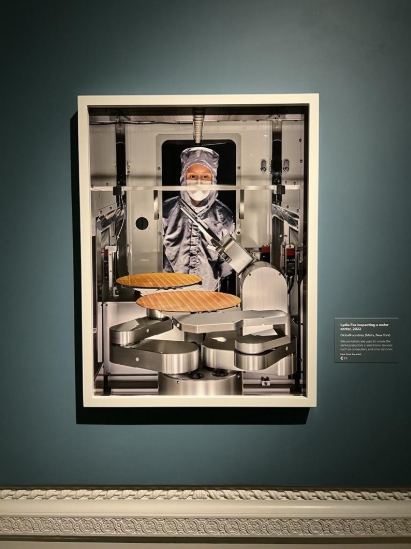
The photo
It's a strikingly round silicon wafer sorter in GlobalFoundries’ fab in Malta, New York. Engineer Lydia Fox, gowned in the proper cleanroom attire, peers into the machine. The moment, captured by photographer Chris Payne, offers a glimpse into a moment most people will never get to see in their lives.
“Even though the fab is mostly automated, humans must keep a watchful eye to ensure that everything runs smoothly,” notes Payne.
Despite manufacturing processes growing increasingly automated, including the ones that images throughout the exhibit capture, it’s a reminder that even in the most advanced environments where machinery executes with precision at a microscopic level, humans still play critical roles in the process to ensure perfection.
Pulling back the curtain on chipmaking
Semiconductor chips are one of the most essential technologies of our time. Up until the pandemic, when shortages disrupted everything from car manufacturing to consumer electronics, awareness of what chips even were was limited. Yet they power nearly every aspect of modern life. Think about the smartphone in your hand, the Alexa on your desk, the car you drive, and even critical medical devices you use.
While awareness of the semiconductor industry has grown more mainstream, the reality of how chips are made remains largely invisible. Most of us experience chips in the form of faster devices, smarter features, more connectivity, but rarely as the result of an astonishingly complex manufacturing process.
That’s what makes Payne’s work inside GlobalFoundries so compelling. His photographs transform what many think of as an abstract, highly technical process into something tangible. From the cleanroom to the wafers to the FOUPs (Front Opening Unified Pods) running overhead, the shots underscore just how intricate semiconductor manufacturing is.
When museums become modern PR
I’ve landed companies in the headlines of top-tier business press, launched category-defining products, and even supported the opening of a basketball arena named after a client. Yet, I can confidently say having photographs of a company I work with in a renowned New York City museum is a first for me.
But museums have long been institutions that shape public understanding – where people walk in ready to learn something. That shift in audience mindset matters. The inclusion of GlobalFoundries in a museum like the Cooper Hewitt, dedicated exclusively to design, reflects a growing recognition that advanced manufacturing isn’t just an industrial story, but one of culture, innovation and society.
By placing semiconductor manufacturing alongside more familiar forms of production, the exhibit builds a new kind of awareness of the industry with those perhaps not as familiar with it. Students, tourists, designers, educators, the curious community of New York City. Most of whom rely on semiconductors every day without ever considering where they come from or how they’re made.
At a time when conversations around domestic manufacturing and supply chain resilience make up the daily news, this kind of cultural integration bridges the gap.
Why it’s worth seeing
In celebration of the nation’s 250th anniversary, the Made in America exhibition is on view at the Cooper Hewitt until September, bringing together more than 70 of Payne’s photographs to illustrate the design ingenuity and innovation of American factories.
If you’re in the area, I’d strongly encourage you to stop by. It’s a rare opportunity to see behind the curtain of industries that typically remain out of sight, and will reshape how you think about the things you use every day.
What our clients say

Ameresco
Leila Dillon, SVP, Corporate Marketing and Communications
It's clear that the Greenough Communications team has a deep understanding of the clean tech and climate transition spaces. Within the first month of working together, they were able to land interviews with The Washington Post, The New York Times and Canary Media, just to name a few! Since working together, we've seen our media coverage and quality increase significantly across the board. We value Greenough's partnership are looking forward to our continued work together.

Boston Micro Fabrication
Laura Galloway, Marketing Director
As a small marketing team, having an agency partner that feels like a true extension of my team is invaluable. The Greenough Communications team is professional, responsive and has taken the time to understand our business, putting our brand in front of the customers who matter for our growth. I’ve been very happy with our first year of partnership and look forward to future success.

Acrolinx
Mariana Just, Vice President, Marketing
We started working with Greenough Communications over a year ago, and it's been a fantastic journey. They really understand who we are at Acrolinx and what we want to say. Their ability to amplify our message in a crowded AI space has been impressive, delivering solid media results in the outlets that matter, securing the AI Breakthrough Award, and boosting our executive team's social media presence. As we continue our partnership, we're excited about expanding our reach and market presence, building upon our refreshed positioning and messaging with Greenough's expertise guiding us every step of the way.

IQE
Steven Curwood, Director of Corporate Marketing
At IQE, one of our goals is to demystify the vital role compound semiconductors play in the industry and the future of innovation. As we aim to broaden our brand's reach in the U.S. market, finding an agency that understands our technology and the intricacies of our work is crucial. Greenough Communications stood out as that agency from the start. In the short time we've worked together, they've already validated our choice with opportunities in key media, including CNBC, NPR, and the U.S. trade media that will move the needle for our brand and message. There's much ahead for us, and we're excited to have the Greenough team by our side.

Arbella Insurance
John Donohue, CEO
Our Greenough team has excelled in learning our business and our challenges and has been extremely effective in developing and executing a PR strategy that helps drive our success.

Wolters Kluwer Health
André Rebelo, Global Marketing Communications & Public Relations
Our Greenough team has been a strategic asset in sustaining targeted growth in our PR and external communications. The team really operates like an extension of our internal team, aligned and effective. They've deftly balanced the needs of multiple sub-groups' objectives and needs, getting great results in the publications our customers read.

GlobalFoundries
Laurie Kelly, Chief Communications Officer
Greenough Communications has been more than just a PR agency for us at GlobalFoundries; they've been true partners. From navigating our IPO to driving impactful education campaigns like the one leading up to the passage of the CHIPS Act, they've been instrumental in showing the world our leadership role in this new technology era. Their knack for building connections with the industry and our team, including our executives, has been impressive. Every year, we throw new challenges their way, and they keep delivering. As we move ahead together, we're excited to keep pushing the boundaries, sharpening our brand narrative, and taking our brand awareness to the next level.

Integrated Marketing
Content Development
Public Relations
Brand Strategy
Integrated Marketing
Content Development
Public Relations
Brand Strategy
Public Relations
Brand Strategy
Integrated Marketing
Content Development
Public Relations
Brand Strategy
Integrated Marketing
Content Development
Let's start a project together.

