
STAT Summit 2026: As Biotech Shifts, Clear Communication Carries More Weight

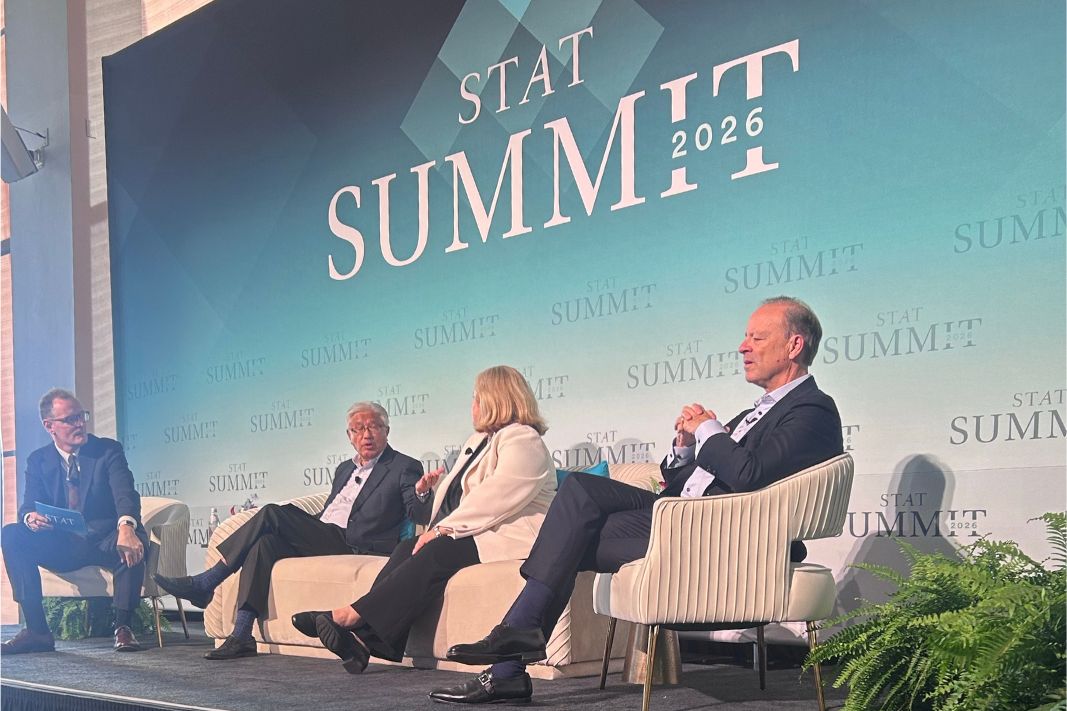
STAT Summit returned to Boston on Oct. 14 and 15, bringing together biotech executives, researchers, policymakers and patients. Three themes ran through the two days: AI is changing how drugs are discovered, the industry is working to rebuild trust in science and the U.S. and China are competing for biotech leadership. Each theme depends on how well the industry explains its work.
AI in drug discovery and other advanced scientific tools
Speakers largely framed AI as something that helps scientists rather than hurts them, and several said it will fundamentally change how drugs are made. Conversations centered on precision, including how to identify patient subsets through biomarkers, how to pursue cancers long considered undruggable and how to derisk early-stage programs before costly later trials. Speakers also touched on how more precise medicine can change patient lives.
Precision health was also on display as Dean Y. Li, M.D., Ph.D., executive vice president and president, Merck Research Laboratories and Stephen Hoge, M.D., president, Moderna, spoke about their cancer vaccine, which leverages AI to better personalize each dose for each patient. The companies announced in August that their messenger RNA cancer vaccine significantly delayed cancer recurrence and metastatic disease in melanoma patients. Their next challenge is proving the approach can work in other tumors.
New technologies are also changing how we understand human biology and the diseases that impact us. Harvard researcher Paola Arlotta discussed her work with brain organoids, which she said could change how scientists think about the brain and disease. They can be grown at scale using robotics and from the cells of many people.
Rebuilding trust in science
Speakers asked how technology that is trustworthy becomes technology that is trusted. Communication, access and acceptance came up as the pieces that matter.
The session “Understanding Vaccine Hesitancy” put that question in concrete terms. Cory Anderson of Penn State College of Medicine and Jennifer Reich of the University of Colorado Denver joined STAT’s Nicholas Florko to discuss what motivates the decision to decline a vaccine, especially when culture, religion and personal beliefs influence the healthcare decisions a person makes. One key takeaway for us all: an emotional reaction can follow when science has not been explained well, and scientific communicators need more humility in how they approach these conversations.
How the U.S. and China biotech industries are evolving
Across the two days, the conversations on China were direct. Speakers said the U.S. needs to invest in solutions to compete if it wants to remain part of the global ecosystem.
In “Biotech’s China Problem,” Francisco Gimenez, a partner at 8VC, pointed to clinical trial speed as a place the U.S. lags. He said the efficiency of finding patient cohorts and building programs is one reason the country is behind.
Rep. Jake Auchincloss added a policy angle during his session. Rather than endorse protectionist measures, he argued the U.S. should be better than China. He also gave a preview of a bill he plans to introduce that would allow early-phase trials to bypass pre-approval evaluation. He also warned that politicizing science funding decisions could undermine U.S. biomedical leadership.
What it means for communicators
All three key themes share a common requirement. As the biotech landscape keeps shifting, clear, open and honest communication becomes part of how companies earn their place.
For AI, that means plain language about what the technology does, where scientists remain in charge and what it has yet to prove. For accelerating scientific and industry progress, it means specific claims about speed, investment and clinical progress that can hold up to scrutiny. For trust, it means starting from humility. People who react emotionally to science often have not been given an explanation that respects their questions.
Companies that explain their science openly, acknowledge uncertainty and speak to people on their own terms will be better positioned as policy, funding and competition continue to change. The science shown at STAT Summit was impressive. How the industry talks about it will shape how far that science reaches.
What our clients say

Ameresco
Leila Dillon, SVP, Corporate Marketing and Communications
It's clear that the Greenough Communications team has a deep understanding of the clean tech and climate transition spaces. Within the first month of working together, they were able to land interviews with The Washington Post, The New York Times and Canary Media, just to name a few! Since working together, we've seen our media coverage and quality increase significantly across the board. We value Greenough's partnership are looking forward to our continued work together.

Boston Micro Fabrication
Laura Galloway, Marketing Director
As a small marketing team, having an agency partner that feels like a true extension of my team is invaluable. The Greenough Communications team is professional, responsive and has taken the time to understand our business, putting our brand in front of the customers who matter for our growth. I’ve been very happy with our first year of partnership and look forward to future success.

Acrolinx
Mariana Just, Vice President, Marketing
We started working with Greenough Communications over a year ago, and it's been a fantastic journey. They really understand who we are at Acrolinx and what we want to say. Their ability to amplify our message in a crowded AI space has been impressive, delivering solid media results in the outlets that matter, securing the AI Breakthrough Award, and boosting our executive team's social media presence. As we continue our partnership, we're excited about expanding our reach and market presence, building upon our refreshed positioning and messaging with Greenough's expertise guiding us every step of the way.

IQE
Steven Curwood, Director of Corporate Marketing
At IQE, one of our goals is to demystify the vital role compound semiconductors play in the industry and the future of innovation. As we aim to broaden our brand's reach in the U.S. market, finding an agency that understands our technology and the intricacies of our work is crucial. Greenough Communications stood out as that agency from the start. In the short time we've worked together, they've already validated our choice with opportunities in key media, including CNBC, NPR, and the U.S. trade media that will move the needle for our brand and message. There's much ahead for us, and we're excited to have the Greenough team by our side.

Arbella Insurance
John Donohue, CEO
Our Greenough team has excelled in learning our business and our challenges and has been extremely effective in developing and executing a PR strategy that helps drive our success.

Wolters Kluwer Health
André Rebelo, Global Marketing Communications & Public Relations
Our Greenough team has been a strategic asset in sustaining targeted growth in our PR and external communications. The team really operates like an extension of our internal team, aligned and effective. They've deftly balanced the needs of multiple sub-groups' objectives and needs, getting great results in the publications our customers read.

GlobalFoundries
Laurie Kelly, Chief Communications Officer
Greenough Communications has been more than just a PR agency for us at GlobalFoundries; they've been true partners. From navigating our IPO to driving impactful education campaigns like the one leading up to the passage of the CHIPS Act, they've been instrumental in showing the world our leadership role in this new technology era. Their knack for building connections with the industry and our team, including our executives, has been impressive. Every year, we throw new challenges their way, and they keep delivering. As we move ahead together, we're excited to keep pushing the boundaries, sharpening our brand narrative, and taking our brand awareness to the next level.

Integrated Marketing
Content Development
Public Relations
Brand Strategy
Integrated Marketing
Content Development
Public Relations
Brand Strategy
Public Relations
Brand Strategy
Integrated Marketing
Content Development
Public Relations
Brand Strategy
Integrated Marketing
Content Development
Let's start a project together.

