
5 Lessons from HubSpot UNBOUND: What It Takes to Make Ideas Travel


AI came up in nearly every session at HubSpot UNBOUND. So did the same question: what does it actually change about how we do the work?
Over three days of main-stage talks, product demos, and hallway conversations, the most useful answers came from people who had already tested something and could tell us what happened. We came home with five lessons on storytelling, channel strategy, measurement, and making room to experiment. Here is what stuck, and what we plan to try with clients first.
Lesson from Mel Robbins: The best ideas are built to travel
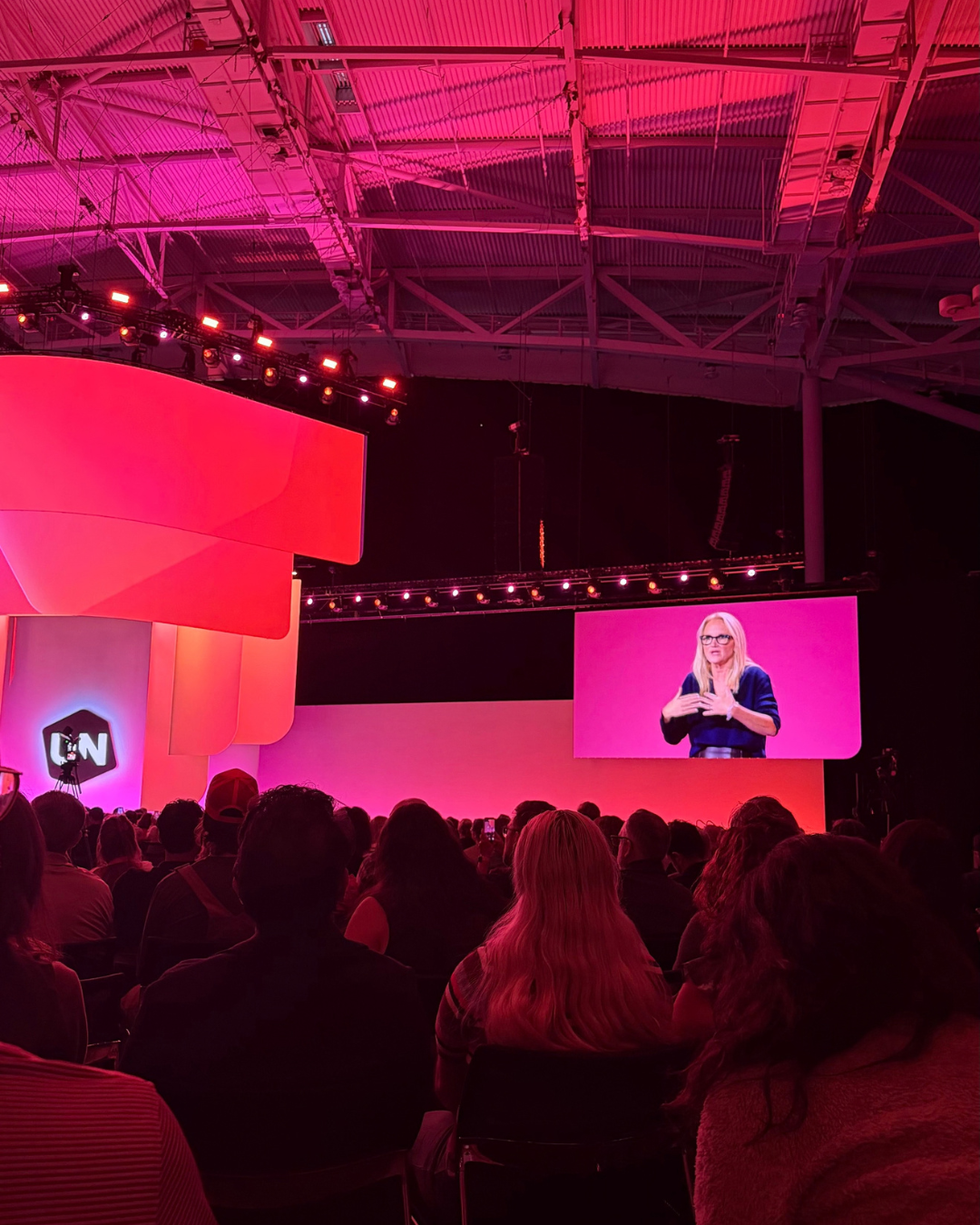
The line that stuck with us from day one was Mel Robbins on the main stage: "It's not who you know. It's who knows you."
What made her session more than a good talk was the strategic communications tactics she used. Great communicators do not just land an idea in the room. They build ideas that travel out of it. Mel named everything and gave each insight an easy handle to remember, from the Let Them Theory to the 5-4-3-2-1 countdown to the moment she said out loud, "here is the magic sentence to steal." She earned trust with specific, located stories, walking the audience through being 800,000 dollars in debt and unemployed at 41, then anchoring it with "just 20 miles from here." And she structured for memory, building her points in threes and carrying the abstract weight with images like "leaders bring the weather."
That is the same discipline we bring to client work. A message only counts if your audience can carry it out of the room and repeat it accurately to someone else.
If your best ideas are not spreading, the problem is usually not the idea. It is the packaging.
Lesson from networking: The surprising channel is often the one your competitors have already decided is not worth their time.
When you get marketers in a room, the obvious questions get the obvious answers. So we tried a different one at UNBOUND: what is the most surprising marketing strategy that has actually worked for you in the last year?
The answers had nothing in common except that each one broke a rule everyone else still follows. One marketer's team found success with door to door marketing in strategically chosen neighborhoods. A wealth management marketer built an educational YouTube series for older audiences, then cut it into short clips for TikTok, where a lot of that demographic already is. And an IoT marketer said optimizing for AI visibility alongside traditional SEO now drives the vast majority of their leads.
Lesson on communication in the age of AI: Making ideas matter
Gamma co-founder and CEO Grant Lee opened his session, "Making Ideas Matter: Communication in the AI Age," with a simple idea: seeing is thinking. Most decks fail because they're built for the person writing them, not the audience receiving them.
Sequencing is where he said to spend disproportionate effort. His pushback on the "one slide per minute" rule was direct: it's too restrictive if you're trying to build tension or curiosity instead of just delivering information. More slides gives a story room to develop, and titles help tell the story. "Q2 Results" tells the room nothing. A title that hints at what happened, or what's at stake, does the work a topic sentence should.
The second layer is design: for attention, not information density, and for a specific audience, not a general one. A slide packed with data might look thorough, but it's asking the room to read instead of listen.
The third layer is shareability, making an idea travel isn't about adding information, it's compression. Lee's example was Apple's original iPod pitch: not a spec sheet, but "1,000 songs in your pocket." A comparison like before-and-after or us-versus-them does the same work. Specific beats comprehensive.
His bonus principle, and the one he seemed to care about most: you are the presentation. Ideas that spread sound like a person, not a template. Be willing to be a little weird, a little unpolished, unmistakably yourself.
That's the discipline worth borrowing for client work. A deck that's technically correct but forgettable has failed the same way a fact sheet fails. If a stakeholder can't repeat your main point after the meeting, the fix isn't more data. It's tighter sequencing, a sharper title, and one line specific enough to stick.
Lesson from marketers: own your audience across channels and content
Marketers are living in a world of "now what?" The old playbooks for channel selection and content production don't hold the way they used to.
The first step is picking a channel with a clear promise and a real cadence for your audience. Newsletters came up often as a winning content type because they take less overhead but still build a genuinely engaged audience. The real filter isn't what's trending, it's where your buyers actually spend time.
HubSpot's content split says it well: marketers lean long-form and visual, sales is on the go and reaches for podcasts, so they built for both instead of picking just one.
For content, winning marketers are building strong AI-powered content engines by continuously iterating and repurposing across channels. One session dove into these winning frameworks being seen across brands:
1. Publish short-form content, identify the topics that outperform your KPI benchmarks, then expand the winners into long-form content.
2. Publish long-form content, identify what performs best, then use AI to break it down into multiple short-form pieces for other channels or socials.
Lesson from Colin Fleming: measure beyond the click, and don't be afraid to fail
Measurement needs a rethink. Colin Fleming, Chief Marketing Officer of OpenAI, shared how he's been thinking about AI, ads, and measurement in this new era. He emphasized keeping focus beyond the click and measuring based on ROI, not just engagement. His main lesson: disassociate achievement from activity. Reach and leads can drop, but if pipeline is up, that's what counts.
The key isn't to chase everyone. Reaching and engaging the right accounts beats the most impressions, every time.
Arguably the most important lesson heard across the sessions: don't be scared to fail, and give your team room to fail too. AI is changing constantly, and most tasks you first hand it will come back rough. Room to dive in, iterate, and keep going is what separates the teams winning right now from the ones stuck waiting to be perfect.
.png)
What our clients say

Ameresco
Leila Dillon, SVP, Corporate Marketing and Communications
It's clear that the Greenough Communications team has a deep understanding of the clean tech and climate transition spaces. Within the first month of working together, they were able to land interviews with The Washington Post, The New York Times and Canary Media, just to name a few! Since working together, we've seen our media coverage and quality increase significantly across the board. We value Greenough's partnership are looking forward to our continued work together.

Boston Micro Fabrication
Laura Galloway, Marketing Director
As a small marketing team, having an agency partner that feels like a true extension of my team is invaluable. The Greenough Communications team is professional, responsive and has taken the time to understand our business, putting our brand in front of the customers who matter for our growth. I’ve been very happy with our first year of partnership and look forward to future success.

Acrolinx
Mariana Just, Vice President, Marketing
We started working with Greenough Communications over a year ago, and it's been a fantastic journey. They really understand who we are at Acrolinx and what we want to say. Their ability to amplify our message in a crowded AI space has been impressive, delivering solid media results in the outlets that matter, securing the AI Breakthrough Award, and boosting our executive team's social media presence. As we continue our partnership, we're excited about expanding our reach and market presence, building upon our refreshed positioning and messaging with Greenough's expertise guiding us every step of the way.

IQE
Steven Curwood, Director of Corporate Marketing
At IQE, one of our goals is to demystify the vital role compound semiconductors play in the industry and the future of innovation. As we aim to broaden our brand's reach in the U.S. market, finding an agency that understands our technology and the intricacies of our work is crucial. Greenough Communications stood out as that agency from the start. In the short time we've worked together, they've already validated our choice with opportunities in key media, including CNBC, NPR, and the U.S. trade media that will move the needle for our brand and message. There's much ahead for us, and we're excited to have the Greenough team by our side.

Arbella Insurance
John Donohue, CEO
Our Greenough team has excelled in learning our business and our challenges and has been extremely effective in developing and executing a PR strategy that helps drive our success.

Wolters Kluwer Health
André Rebelo, Global Marketing Communications & Public Relations
Our Greenough team has been a strategic asset in sustaining targeted growth in our PR and external communications. The team really operates like an extension of our internal team, aligned and effective. They've deftly balanced the needs of multiple sub-groups' objectives and needs, getting great results in the publications our customers read.

GlobalFoundries
Laurie Kelly, Chief Communications Officer
Greenough Communications has been more than just a PR agency for us at GlobalFoundries; they've been true partners. From navigating our IPO to driving impactful education campaigns like the one leading up to the passage of the CHIPS Act, they've been instrumental in showing the world our leadership role in this new technology era. Their knack for building connections with the industry and our team, including our executives, has been impressive. Every year, we throw new challenges their way, and they keep delivering. As we move ahead together, we're excited to keep pushing the boundaries, sharpening our brand narrative, and taking our brand awareness to the next level.

Integrated Marketing
Content Development
Public Relations
Brand Strategy
Integrated Marketing
Content Development
Public Relations
Brand Strategy
Public Relations
Brand Strategy
Integrated Marketing
Content Development
Public Relations
Brand Strategy
Integrated Marketing
Content Development
Let's start a project together.

